
Trace Woodson County Former Owners by Record Era
Tracing former owners in Woodson County means walking the parcel backward. Each step is one recorded conveyance at a time. The current deed names the seller who conveyed it. That seller's own deed names the one before. Woodson County publishes no online Register of Deeds cutoff date. So a careful search works in three layers: the current parcel card, the courthouse deed indexes and books, and the older archival holdings. Treating these as separate eras beats expecting one seamless online property records span that does not exist.
| Source | Years It Covers | Where Held | What It Shows |
|---|---|---|---|
| CIC parcel card | Current tax card; online start not stated | Appraiser portal | Present owner display and deed reference |
| ROD index and deed books | Official online cutoff not published | Room 101, courthouse | Successive grantors, grantees and legal descriptions |
| KSHS Woodson holdings | 1858-1962 | State Archives microfilm and volumes | Register of Deeds, probate, estate and cemetery deed material |
| Federal tract books | Public-domain land era; local run unstated | KSHS and federal repositories | First purchaser by legal description |
Start every search with CIC, even for a purely historical question. Its APN, PID, legal description, and document reference all point to the same parcel of land, which keeps your Woodson County property records anchored. From there, follow the deed chain backward until county property records give way to a federal patent or a tract-book entry.
Build a Woodson County Former-Owner Timeline
A good timeline records what each instrument actually says. Surnames alone prove little. Give every confirmed transfer its own row in the deed records, then note wherever probate, a tax sale, a foreclosure, a correction, or a plat change breaks the expected order of owners of record.
| Recorded date | Grantor to grantee | Instrument | Book/page or document |
|---|---|---|---|
| Newest confirmed date | Prior owner to current grantee | Deed type as recorded | CIC reference plus ROD confirmation |
| Earlier date | Earlier grantor to that prior owner | Warranty, quitclaim, fiduciary, or other deed | Exact local reference |
| Chain event | Estate, county, sheriff, or other party | Order and later conveyance | Court case plus recorded result |
| First county link | Patent holder to first local grantee | Patent or first deed | Tract-book and deed references |
Never push a name backward through the tax roll unless the legal description matches. The same surname can appear on several parcels, and an old street address may no longer exist in Woodson County records.
Woodson County Has No Published Online Deed Cutoff
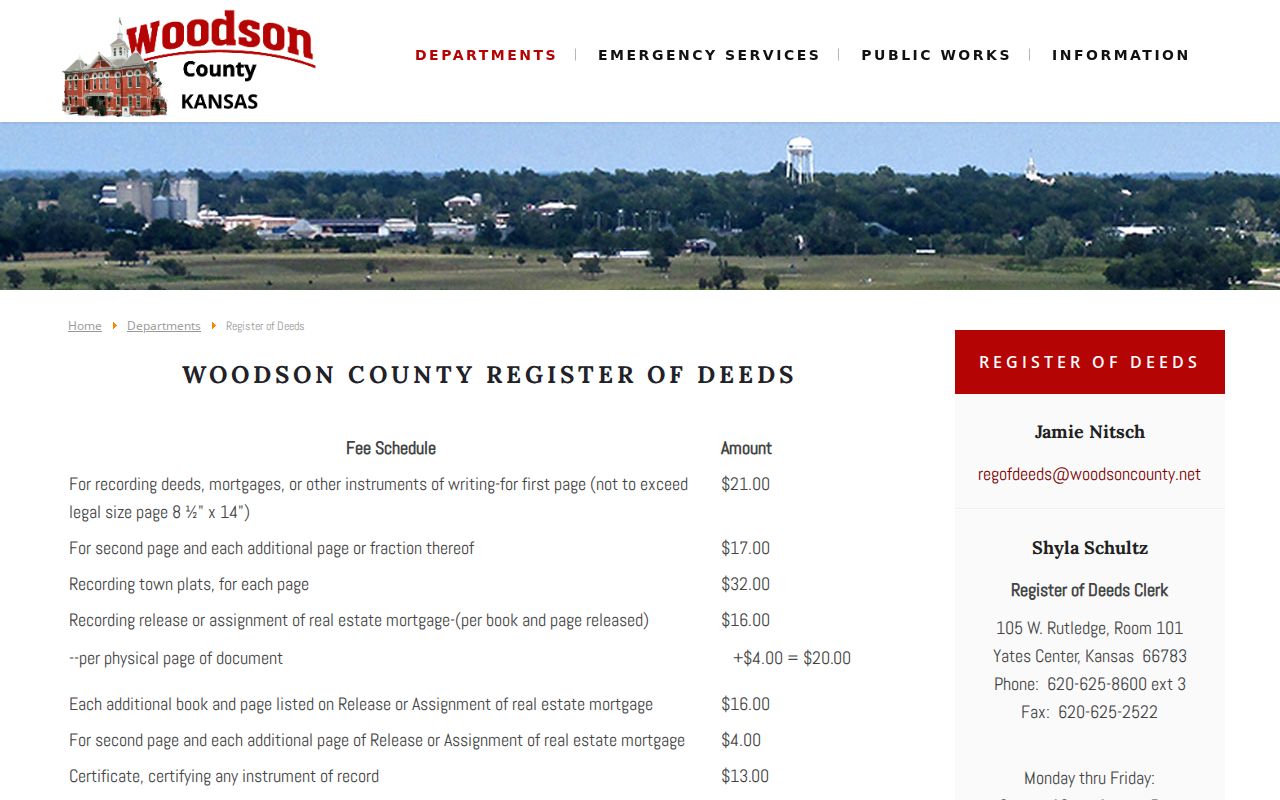
The Register of Deeds page posts office contacts and fees, but Woodson County publishes no online grantor-grantee portal and no first-online year for deed records. The Kansas Register of Deeds Association notes that a county's holdings may sit in paper books, on microfilm, as images, or in hand-built indexes. Formats vary county by county. A guessed cutoff year would mislead any prior-owner search here.
Use the offline route. Visit Room 101 at 105 W. Rutledge in Yates Center. Call 620-625-8600 ext. 3, email regofdeeds@woodsoncounty.net, or send a focused written request. Hours run 8 a.m. to noon and 1 to 5 p.m., Monday through Friday. Bring the legal description. Plan around the noon closure.
Start Woodson County Prior-Owner Work at the ROD
The official Woodson County Register of Deeds page covers the local counter, staff, hours, and copy categories. Start every prior-owner property search there.
Ask which format holds your years. Books, microfilm, images, or hand indexes may cover them. A document reference such as D121-320 or D119-45 is a concrete lead, though ROD staff should say whether it maps to a book and page or another local numbering scheme.
Extend Woodson County Previous Owners into KSHS Holdings
The Kansas Historical Society Woodson collection covers county records from 1858 through 1962 in 35mm microfilm and bound volumes.
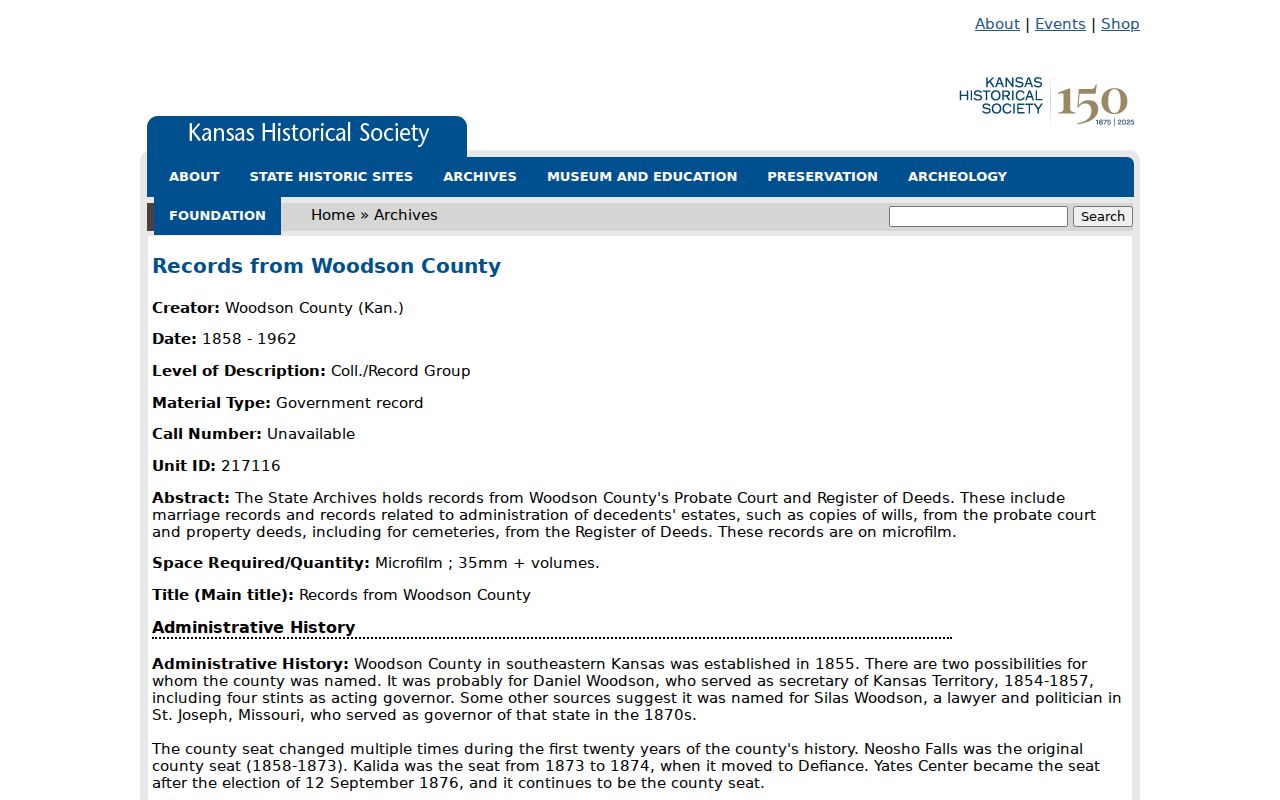
The society's Woodson County holdings span Probate Court files, Register of Deeds volumes, deeds, wills and estate papers, marriages, and cemetery deeds. Staff can pull the reel or volume you need once you submit its access form. A plat or patent book on permanent retention is preserved for the long haul. Preservation, though, is not the same as a scan. You cannot open one from home.
Go Before Woodson County Deeds with Federal Tract Books
Kansas opened as public-domain land, so ownership starts federally. A federal tract book entry can record the legal description, purchaser or grantee, acreage, price per acre, total purchase amount, sale date, and the law under which the sale ran. The catch is indexing. These books run by legal geography, not owner name, so bring a section-township-range or other land-office description before you search.
The oldest defensible chain looks like this: a federal patent or tract-book entry, the first county deed, later deeds and encumbrances, any probate or tax-sale event, and finally the modern parcel card. A current CIC document number proves nothing about first ownership. One legal description threads every era together.
Search Former Owners Across Woodson County Seat Changes
County seat names are practical index terms for tracing former owners. Woodson County kept its seat at Neosho Falls from 1858 to 1873. Then came Kalida until 1874 and Defiance until 1876. Yates Center won the September 12, 1876 election, and the seat stays there still. A deed, probate item, or published notice may carry whichever place name was current. That detail matters when the paper was filed. It also matters when an index search stalls.
The physical moves explain odd gaps in the records. Local history reports courthouse buildings and homes hauled from Defiance. A hotel was moved from Kalida by ox team. Search those predecessor names alongside the current town. Also try the township, addition, lot and block, or rural legal description. Toronto adds one more wrinkle. Try its Pleasant Grove post-office variant too.
Resolve Probate and Tax-Sale Breaks in the Chain
Former owners rarely connect through a clean buyer-to-seller deed. A death can produce probate orders and a fiduciary conveyance instead. A delinquent tax account may run from list to petition. It can then move through notice, redemption, sale confirmation, and sheriff deed. A foreclosure filing sometimes ends in dismissal or release, with no transfer at all. Each break has its own paper trail.
Read the operative court record first, then hunt down the recorded instrument. Woodson County sits in the 31st Judicial District. Rule 22 backs a public portal index plus a courthouse terminal, with nonpublic exclusions. Before treating a listed owner as displaced by a tax sale, confirm payoff and redemption details with the Treasurer.
Use Woodson Plats and Newspapers as Supporting Proof
A plat anchors the same ground even when street names shift over the decades. Request the original, amended, or vacating plat. Give the addition name, lot, block, and predecessor name. Add the approximate recording period. Plats can show streets, alleys, the surveyor, approvals, and prior references. They can also reveal the source tract behind a Woodson County parcel.
KSHS lists 179 Woodson newspaper records. Those reels carry probate notices, sheriff sales, tax delinquencies, road vacations, and conveyances. Pair the owner surname with the legal description. Try terms like executor, quiet title, redemption, and lien. A notice is only context; the deed or final order still controls the chain evidence. For single copies, use the Woodson County deed records guide.
Reconstruct Woodson County Previous Owners Backward
Start with the newest deed you can confirm and work backward toward the oldest. Log every transfer in its own row so names, legal descriptions, recording dates, and cross-references never blur together.
- Use the current CIC document reference and legal description to obtain the newest deed.
- Copy its grantor, grantee, recording date, deed type, book/page or document number, and exact tract.
- Search the grantor as an earlier grantee, then compare the tract before accepting the match.
- Repeat through paper, image, microfilm, or hand indexes and state where the evidence ends.
- Grantor / grantee
- The party conveying an interest and the party receiving it.
- Chain of title
- The ordered sequence of instruments affecting the same land.
- Reverse index
- An index route used to find a party in the opposite grantor or grantee role.
- Warranty / quitclaim deed
- Different deed forms whose legal effect must be read in the instrument.
State How Far Woodson County Prior Owners Can Be Proven
KSHS traces its Woodson County holdings from 1858 through 1962. That range describes the collection alone. It is not a promise that every deed image is online or that every sequence is complete. The county courthouse also has no record of a fire. Nor is there a lost decade in its deed files. Absence of loss is not a guarantee of uninterrupted survival. Expect gaps of the ordinary kind rather than catastrophe.
Use historical names with care. Research past owners for house history, estate work, or property diligence, never to target or harass a living person.